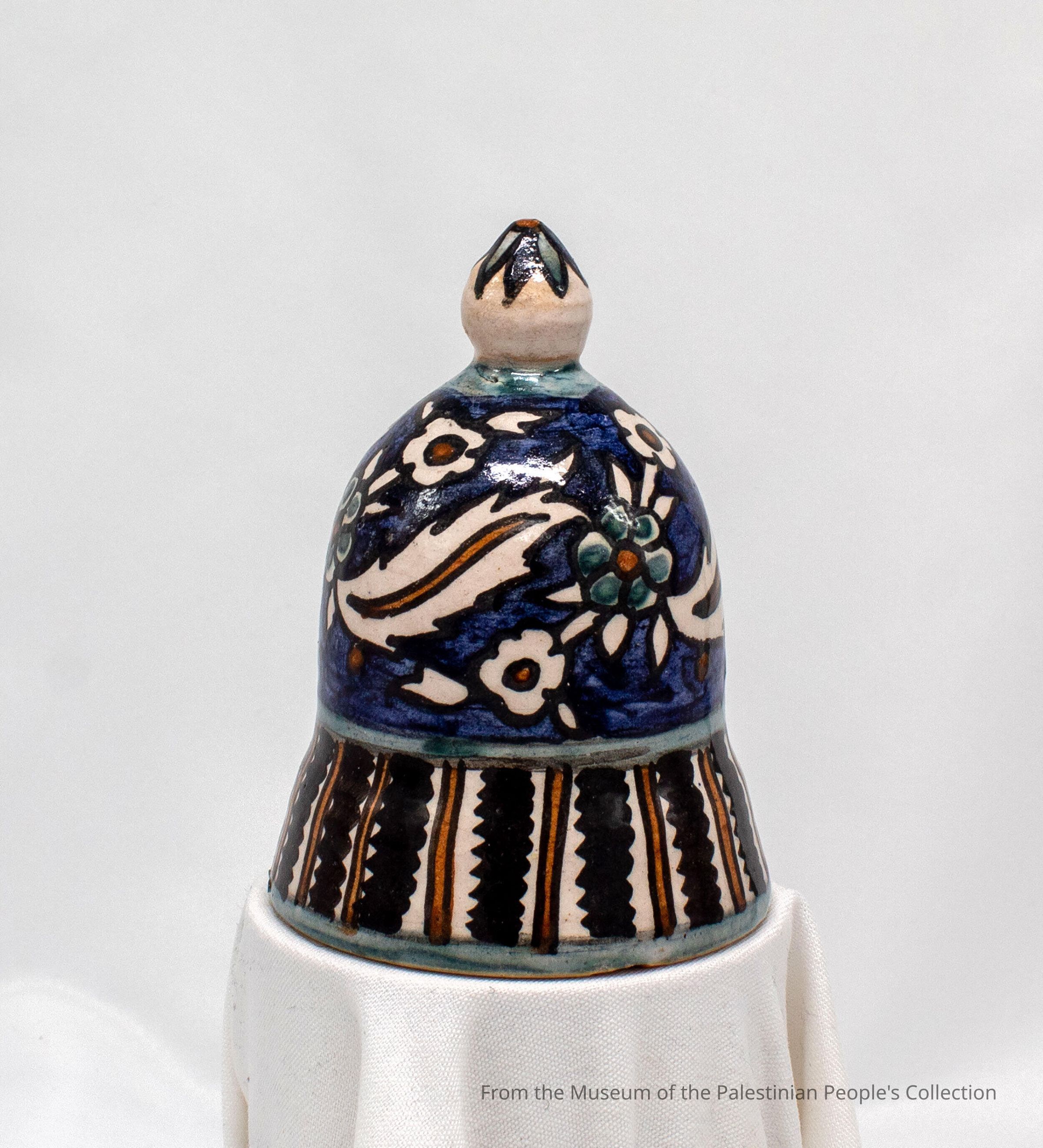
Armenian ceramics have been an important part of Jerusalem’s artistic landscape for more than a century. The tradition was established in Jerusalem in the early 1920s by Armenian ceramicists from the Kütahya tradition and flourished under the British Mandate and later during the period of Jordanian rule. Armenian ceramicists developed a distinctive style of hand-painted pottery and tilework that became closely associated with Jerusalem and was appreciated by the city’s diverse communities.
This ceramic bell is signed by Marie Balian (1925–2017), a French-Armenian artist and ceramic painter renowned for her distinctive tile murals and her role in shaping the artistic identity of Armenian ceramics in Jerusalem. Near her signature, Balian has written “Jerusalem” and “Jordan,” suggesting that the bell was produced in Jerusalem after 1948, when it was under Jordan rule. The inscriptions reflect the changing political geography of Jerusalem and Palestine during the period in which Balian worked: from 1948 to 1967, East Jerusalem, including the Old City.
Balian expanded the visual vocabulary of Armenian ceramics by incorporating Armenian cultural and natural motifs, including trees, gazelles, birds, and peacocks, into compositions traditionally dominated by more static floral and architectural designs. Her richly populated scenes of gardens, animals, and birds became associated with her distinctive “Gardens and Views of Paradise” style.
Balian’s work brought Armenian ceramics of Jerusalem to international attention. In 1992, the Smithsonian Institution presented "Views of Paradise: Tile Paintings by Marie Balian," an exhibition of her work at the Ripley Center in Washington, D.C. The exhibition later traveled to the Armenian Library and Museum of America (ALMA) in Boston. Her work was also exhibited at the Eretz Israel Museum in Tel Aviv and in Alicante, Spain, in 2003. Through her artistry, Balian helped establish Armenian ceramics of Jerusalem as a distinctive and internationally recognized artistic tradition.
This bell is therefore significant as an object that connects Jerusalem’s Armenian ceramic tradition with the historical geography of Palestine and Jordan and with the international recognition of Armenian ceramic art.
2021.008
On View
Permanent Collection
Wafa Ghnaim
Ethnographic Collection
Gift of Nidal and Melissa Jarrard-Mahayni
Marie Balian
Ceramicist
Marie Balian
circa 1960 - circa 1990
20th Century
Jerusalem (القدس)
Jerusalem (الْـقُـدْس)Palestine (فِلَسْطِين)
Asia
3 in
5 in
Glazed ceramic
Virginia
United States of America
North America
type: travel
date: 1960's
certainty: approximate
notes: After the ceramic bell was purchased, it was preserved by the donor in the United States.
Washington, DC
District of Columbia
United States of America
North America
type: travel
date: 2019
certainty: precise
notes: The donor loaned the object to the museum for display.
Washington, DC
District of Columbia
United States of America
North America
type: travel
date: 2025
certainty: precise
notes: The donor formally donated the object to the museum's collection.