
MPP CatalogIt Item Details
Fadwa Tuqan (1917-2003)
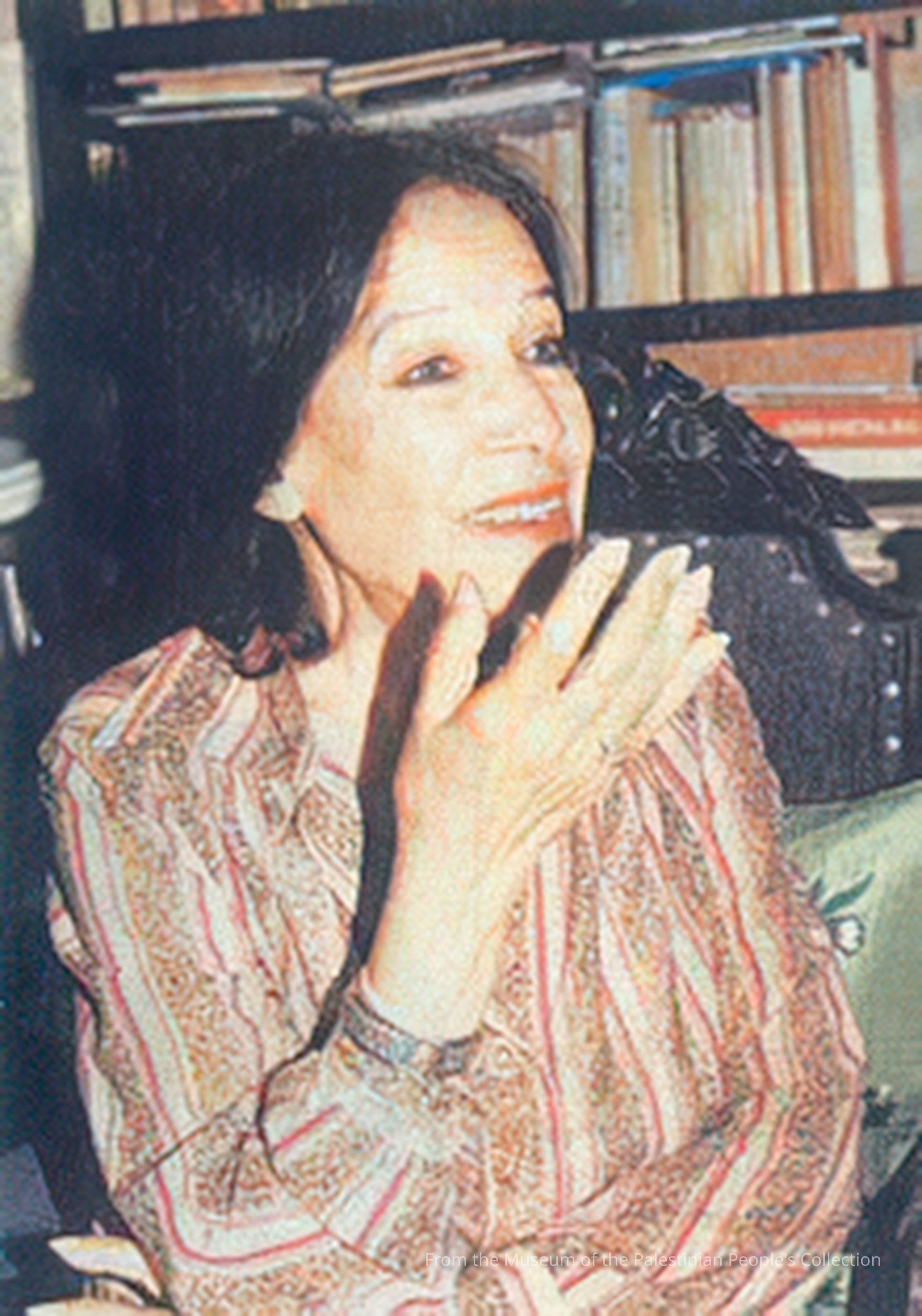
MTM.019
On View
Making Their Mark
Wafa Ghnaim
Images/Bio Sources: https://www.palestine-studies.org/en/node/1653278 https://en.wikipedia.org/wiki/Fadwa_Tuqan https://www.palquest.org/en/biography/6580/fadwa-tuqan
Historical Note
Fadwa Tuqan (1917-2003) was a Palestinian poet known for her resistance poetry and remembered as the leading female poetess of Palestine. Born in Nablus, Mandatory Palestine, she grew up within a wealthy family. After quitting school at age 13 due to illness, her brother Ibrahim Tuqan tutored her in poetry. With the Nakba came an influx of refugees into NAblus from the lost cities of Jaffa, Haifa, and West Jerusalem. The death of her strict father and the mixing of different Palestinian city cultures was in some sense personally liberating for Tuqan, as she experienced the decline of feudalism and the acceptance of young and educated women into social spheres previously only inhabited by their male counterparts. Her first poetry collection, My Brother Ibrahim (1946) was later followed by seven others, translated into various languages. Her collections chronologically trace the evolution of Palestinian political consciousness., from victimhood to summud (steadfastness) and beyond. Her autobiography, "Mountainous Journey" (1990) explores the restrictions of women within Palestinian and Arab society. Israeli and Jewish feminists forged connections with Tuqan despite the physical separation. She studied English Language and Literature at Oxford University from 1962-1964, and traveled extensively throughout Europe and the Middle East. In 1990, she was awarded the Jerusalem Award for Culture and Art. She also won prizes for her poetry from Greece, Jordan, and Italy, and served on the board of trustees for An-Najah University in Nablus. Fadwa Tuwa died in December of 2003, as Nablus was under siege during the Second Intifada. She is remembered as one of the most distinguished figures of modern Arabic literature.