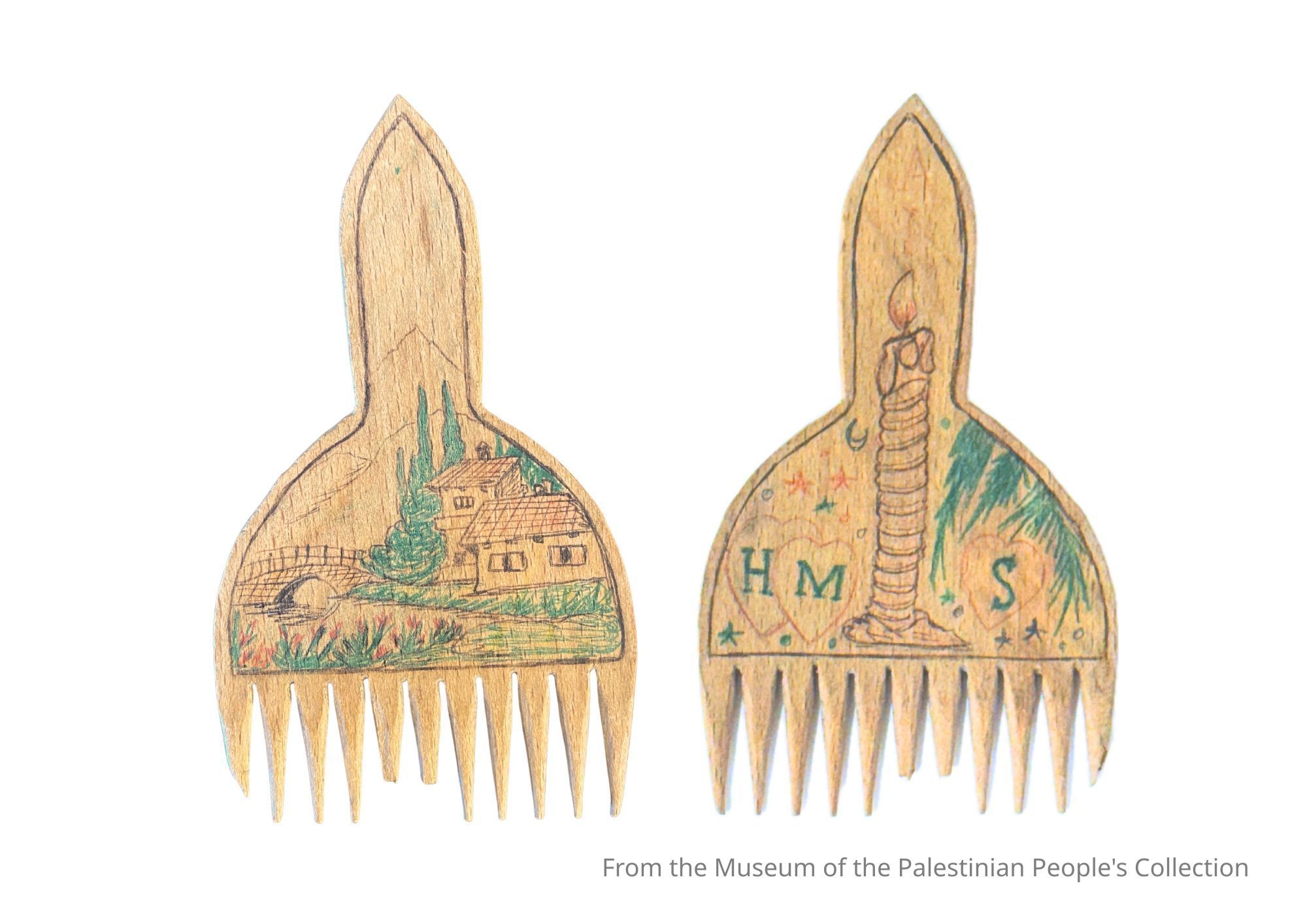
Wooden Comb of Imprisoned Palestinian in Ansar Prison, Handmade (1982-1984)
Object/Artifact
This is a hand-carved wooden comb made by an imprisoned Palestinian in Ansar Prison in southern Lebanon. After the 1982 Israeli invasion of Lebanon, the occupation forces built a prison camp outside Ansar (Arabic: أنصار; also spelled Insar) in southern Lebanon. The imprisoned people lived in small tents surrounded by 4 meter high barbed wire fences. Ansar was known for its extremely poor conditions, and its abusive treatment that included torture, rape, and starvation. 12,000 detainees passed through its gates; the youngest was twelve; the oldest was eighty-five. Nearly 90% of which were civilians. Despite this, certain small items did circulate inside, such as ink pens, wood scraps, and improvised tools that could only be accessed sporadically through guards, visitors, or shared supplies within the camp. The comb is shaped from a thin scrap of wood, likely cut from a food crate or another piece of camp material, using improvised tools such as a razor blade, a metal shard, or a piece of glass. Its surface is decorated on both sides with red, green, and black ballpoint-pen ink.
One side features a village landscape: a house with shuttered windows, cypress trees rising behind it, a stone bridge, and plants along the foreground. It is so detailed, it seems to be a place in the memory of the artist, a scene reconstructed from memory, longing, or a hope for freedom. The opposite side bears a candle, alongside a green palm frond and the initials H M S in hearts, surrounded by small stars. The candle may represent the soul of someone lost. The palm frond may speak to steadfastness or paradise, or to a particular tree in his village in Palestine. The initials are the greatest mystery: Were they the initials of his martyred son or brother? Someone he hoped to honor? His own childhood nickname? The name of the person he intended this comb for? Or the memory of someone he might never see again? The comb invites such questions, but cannot answer them. Prison-made objects often hold meaning that cannot fully be recovered. They carry the maker’s presence, but also his silence. What we can see is his handwork: the evenly spaced teeth cut without proper tools; the steady ink lines despite limited materials; the permanence of the ink itself; the choice to decorate both sides when he could have left it plain.
The donor, Marcia Stone, served as a nurse with the International Rescue Committee and was stationed in Lebanon on the edge of Ain al-Helweh camp. Between 1982 and 1985, she worked as an American volunteer nurse in a private hospital in Nabatiyya, a southern Lebanese town under Israeli occupation. During this period, she traveled to Ain al-Helweh, where she received this object, along with others, from Mahmoud Kassem, a former prisoner of Ansar who, after his release, worked alongside her in the same healthcare unit.
2024.10.14a
On ViewBayt wa Balad
Permanent Collection
Wafa Ghnaim
Ethnographic Collection
Maker Once Known
Maker
1982 - 1984
Ansar (أنصار)
Lebanon (لُبْنَان)
Asia
Ain al-Hilweh Camp
Lebanon (لُبْنَان)
Asia
Sidon
type: travel
date: 1984
certainty: precise
notes: The wooden comb was made by an imprisoned Palestinian man in Ansar Prison, and given to another imprisoned Palestinian man, Mahmoud Kassem. Kassem was released from Ansar and carried the wooden comb, along with other objects, to Ain al-Hilweh Camp, where he worked in a small health-care unit with the donor, Marcia Stone, and it was there that he gave the objects—including this wooden comb—to Stone.
Washington State
United States of America
North America
type: travel
component: wood, ink
date: 1985-2024
certainty: precise
notes: Stone eventually retires in Seattle, Washington and determines that she would like to donate the object to the museum.
Washington, DC
District of Columbia
United States of America
North America
type: travel
date: 2024
certainty: precise
notes: Stone donates and ships the objects to the Museum of the Palestinian People.
2024.10.14b
2024.10.14c
2024.10.14d
2024.10.14e
Courtesy of Marcia Stone
By way of Mahmoud Kassem, Donated October 21, 2024