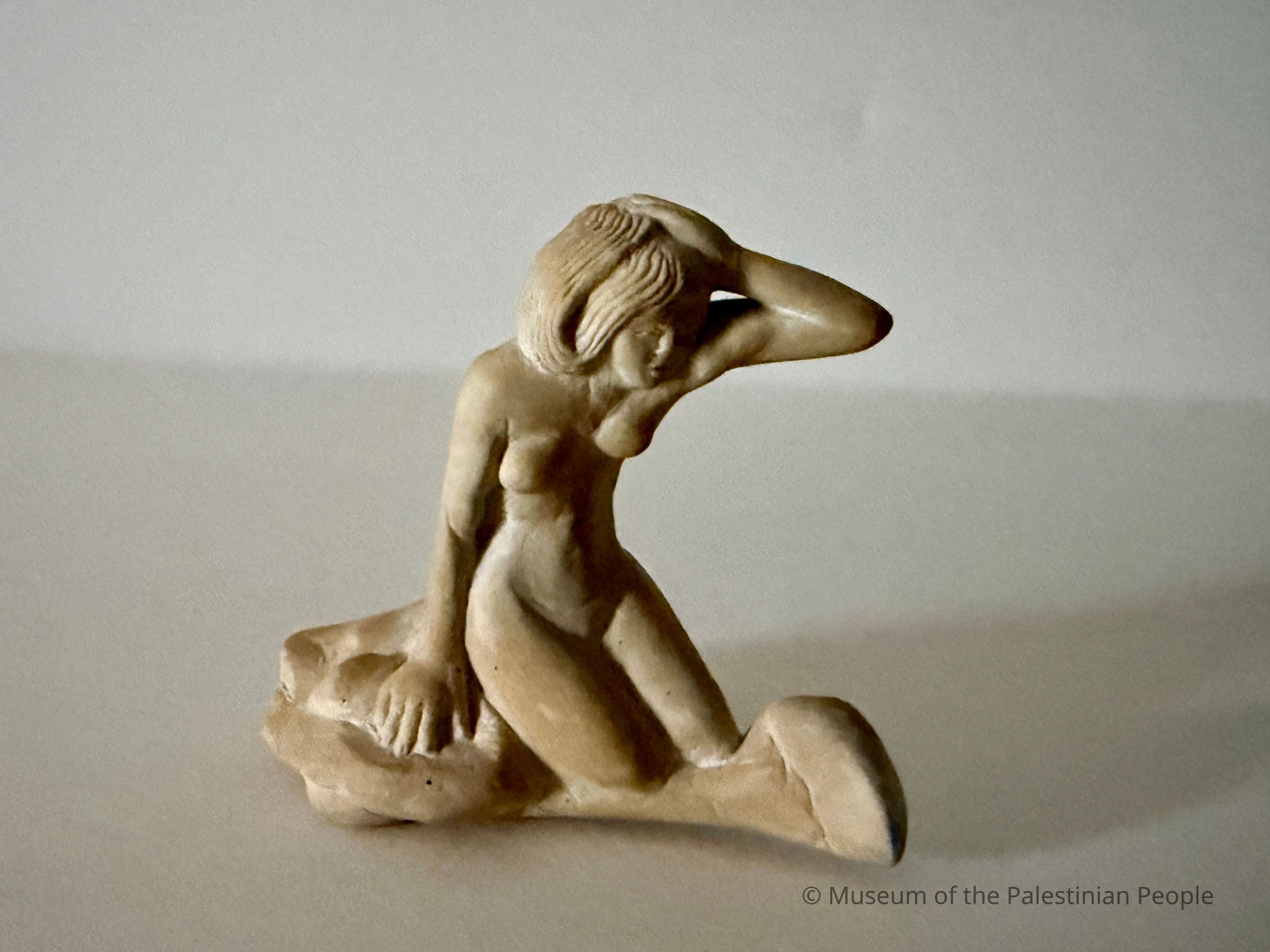
This is a small, hand-carved stone figure made by an imprisoned Palestinian in Ansar Prison in southern Lebanon. After the 1982 Israeli invasion of Lebanon, the occupation forces built a prison camp outside Ansar (Arabic: أنصار; also spelled Insar), where imprisoned people lived in small tents surrounded by four-meter-high barbed-wire fences. Ansar was known for its extremely poor conditions and its abusive treatment that included torture, rape, and starvation. Twelve thousand detainees passed through its gates; the youngest was twelve, the oldest was eighty-five, and nearly ninety percent were civilians. Despite these conditions, small materials did circulate inside the camp—stones, scraps of cord, and the occasional pen—accessed only sporadically through guards, visitors, or shared prisoner supplies.
The figure was carved by a Palestinian detainee who told donor Marcia Stone that he shaped the sculpture from a stone he picked up inside the camp, carving it entirely with a Bic pen, using the hardened metal tip of the pen to scrape, score, and incise the stone over time. The resulting figure depicts a seated woman with her hand lifted across her brow, her form leaning forward in a gesture that could be read as modesty, contemplation, or simply the expressive posture that was allowed by the shape of the stone. In the museum display case, the sculpture rotates on its mount independently and often turns to face the mirror at the back of the case. Whether this recurring orientation is coincidence, balance, modesty, or vanity remains unknown.
After his release from Ansar, the former prisoner worked as the head nurse in a small healthcare unit in Ain al-Hilweh Camp. Known for his skill and kindness, he later left Lebanon with his family for Libya, where he is believed to have died. Stone explained that she has no means of contacting his surviving family to obtain permission to publicly attach his name to his work; as curator, the question of whether his name should remain internal or appear publicly remains an ethical decision that must be discussed by the Bayt wa Balad team.
The stone figure—along with a beaded necklace (2024.10.14d)—was kept by the former prisoner's daughter in a family box of treasured belongings. When Stone visited their home in Ain al-Hilweh, the daughter showed her the box; when Stone admired the objects, the daughter offered them to her. In Palestinian culture, it is believed that if someone admires something in your possession it attracts the evil eye, which is bad luck. Giving the object to the person protects one from the evil eye. Stone initially refused, saying she could not accept such personal treasures, but the former prisoner insisted: the sculpture belonged to his daughter, and if she wished to give it, Stone could not refuse. Stone later reflected on the encounter as one of the many lessons she learned in the camp and from the Palestinians she met there—about generosity, hospitality, and the fragile importance of objects that circulate across borders, marked by displacement.
2024.10.14c
On ViewBayt wa Balad
Permanent Collection
Wafa Ghnaim
Ethnographic Collection
Maker Known, Name Redacted
Maker
1982 - 1984
Ansar (أنصار)
Lebanon (لُبْنَان)
Asia
Ain al-Hilweh Camp
Lebanon (لُبْنَان)
Asia
Sidon
type: travel
date: 1984
certainty: precise
notes: Prisoner was released from the prison, and Stone visited him at his home. Prisoner's daughter gave the sculpture to Stone.
Washington State
United States of America
North America
type: travel
date: 1985-2024
certainty: precise
notes: Stone eventually retires in Seattle, Washington and determines that she would like to donate the object to the museum.
Washington, DC
District of Columbia
United States of America
North America
type: travel
date: 2024
certainty: precise
notes: Stone donates and ships the objects to the Museum of the Palestinian People.